
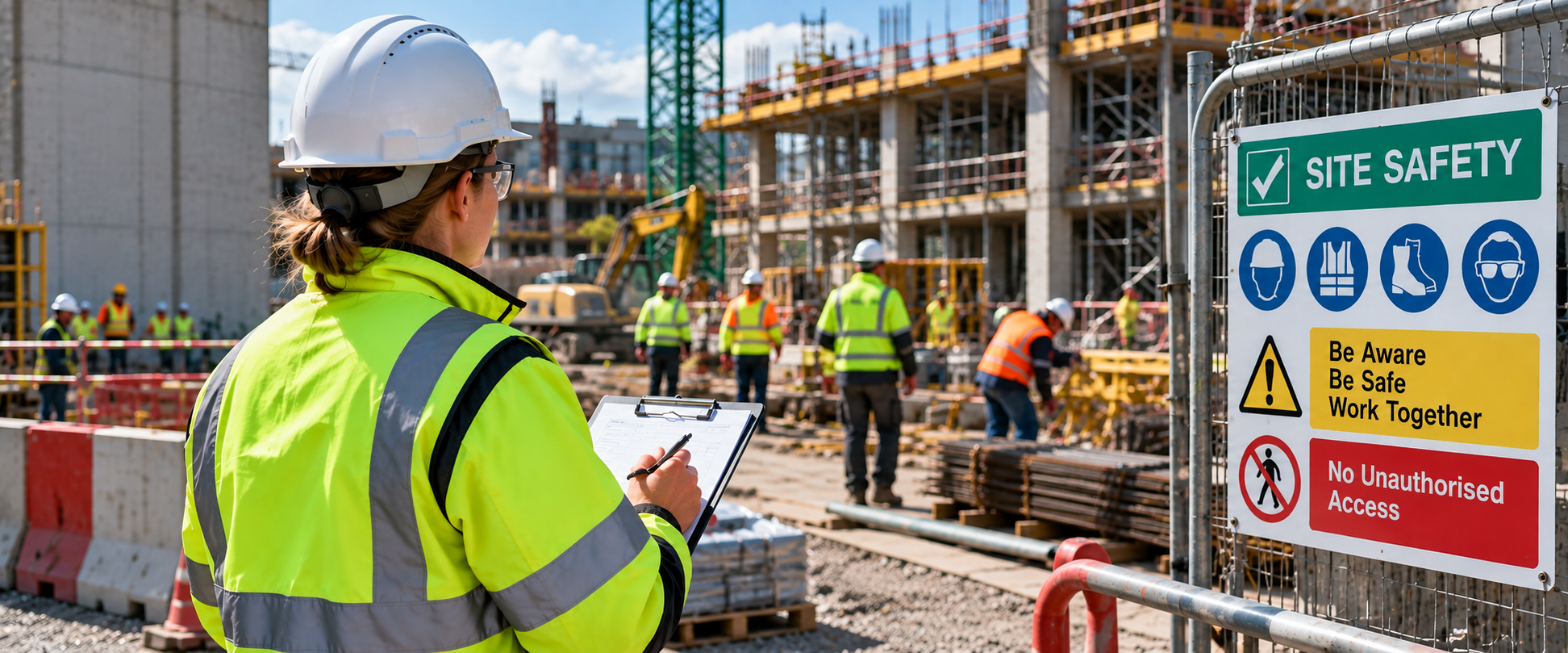
Health and safety is the only function on a construction project where doing the job perfectly produces no visible evidence that anything happened. Nothing occurred. That was the point.
It is a genuine difficulty for the discipline, and it explains a lot about how the role is understood from the outside. On major projects in Ireland, where the safety function is properly resourced and properly integrated, the work is substantial and highly skilled. Almost none of it is visible in the finished building.
The measurement problem
The instinct is to judge a safety function by what it recorded. Incidents, near misses, reportable events, days lost. Those numbers matter and they are not optional, but they describe what got through.
The real measure is the set of things that never reached the site: the risk designed out at an early workshop, the lift sequenced differently so the load never passed over an occupied area, the activity stopped for two hours while the access was rebuilt properly. None of those appear on any dashboard, which is why a strong safety function can look, on paper, like a quiet one.
Early enough to change the plan
The clearest difference between a safety professional who is listened to and one who is merely tolerated is when their view arrives.
A safety view that arrives at planning stage changes the plan. It shapes the sequence, the access, the temporary works and the programme allowances, and by the time the work reaches the site the risk has already been reduced by design. A safety view that arrives on the day the work starts can only stop it, which is expensive, unpopular and far less effective.
The professionals who build real influence tend to be the ones who push for a seat at the earlier conversation rather than the authority to halt the later one. On a large project with a Tier 1 contractor that early involvement is usually built into the structure. On smaller schemes it often has to be earned.
What a genuine safety culture looks like
The test is simpler than most of the language around it suggests. People raise things early, and nothing bad happens to them for it. That is the whole test.
Everything else follows from whether that is true. When it is, problems arrive while they are still small and cheap to fix, and the safety function spends its time on prevention. When it is not, issues surface late, usually as an incident or as a piece of work that has to be undone, and the function spends its time on investigation instead.
Posters, notice boards and briefings that nobody reads are not the culture. They are what a site produces when it wants the appearance of one.
The discipline changes with the risk profile
The principles hold everywhere; the day to day does not. What actually varies is the dominant risk. Work at height and lifting operations drive the picture on a tall residential build. Excavations, plant movement and public interface drive it on a civils or utilities scheme. On a live operational site, an airport or a working facility, the defining constraint is that other people are using the place while you build in it.
Professionals who move well between these environments read the new risk profile quickly and adjust their focus without losing the fundamentals. That adaptability is difficult to build and harder to replace, and it is one of the strongest things a safety professional can bring into a conversation about their next move.
Influence without authority
Very little of the role is exercised through formal power. A safety professional is usually asking people to work differently, often under programme pressure, and the response depends almost entirely on whether they are credible with the trades and the site team.
That credibility comes from being right about the things that genuinely matter and being practical about the things that do not. The advisors and managers who are respected on site tend to be the ones who understand how the work actually gets done, who raise issues without theatre, and who are known to be firm on a small number of things rather than uniformly rigid about everything.
The cost of getting it wrong
The commercial consequences of a serious safety failure are severe. The work stops, the investigation runs, the programme and the reputation both take damage, and the effects follow a business into future tenders.
That is not the main cost. The main cost is that someone does not go home. Everything else in the discipline sits underneath that, and the professionals who do this work well never lose sight of it.
Where the demand sits in Ireland
Safety demand follows the live pipeline, and the pipeline in Ireland is currently broad rather than concentrated. Central Statistics Office figures published in August 2026 show residential building output up 5.5% in the second quarter and civil engineering up 3.1%, while non residential building fell 9.7%.
In practice that means residential and civils programmes are generating a good share of the current requirements, alongside the continuing demand on major infrastructure and industrial projects. For an experienced safety professional it is a market with real choice in it, which makes it worth being deliberate about the kind of project you take on next rather than simply the next one offered.
Necto Selection works with health and safety professionals across Ireland, from Advisors and EHS Officers through to safety leadership on major projects. Contact the team for a direct conversation about the next move.

