
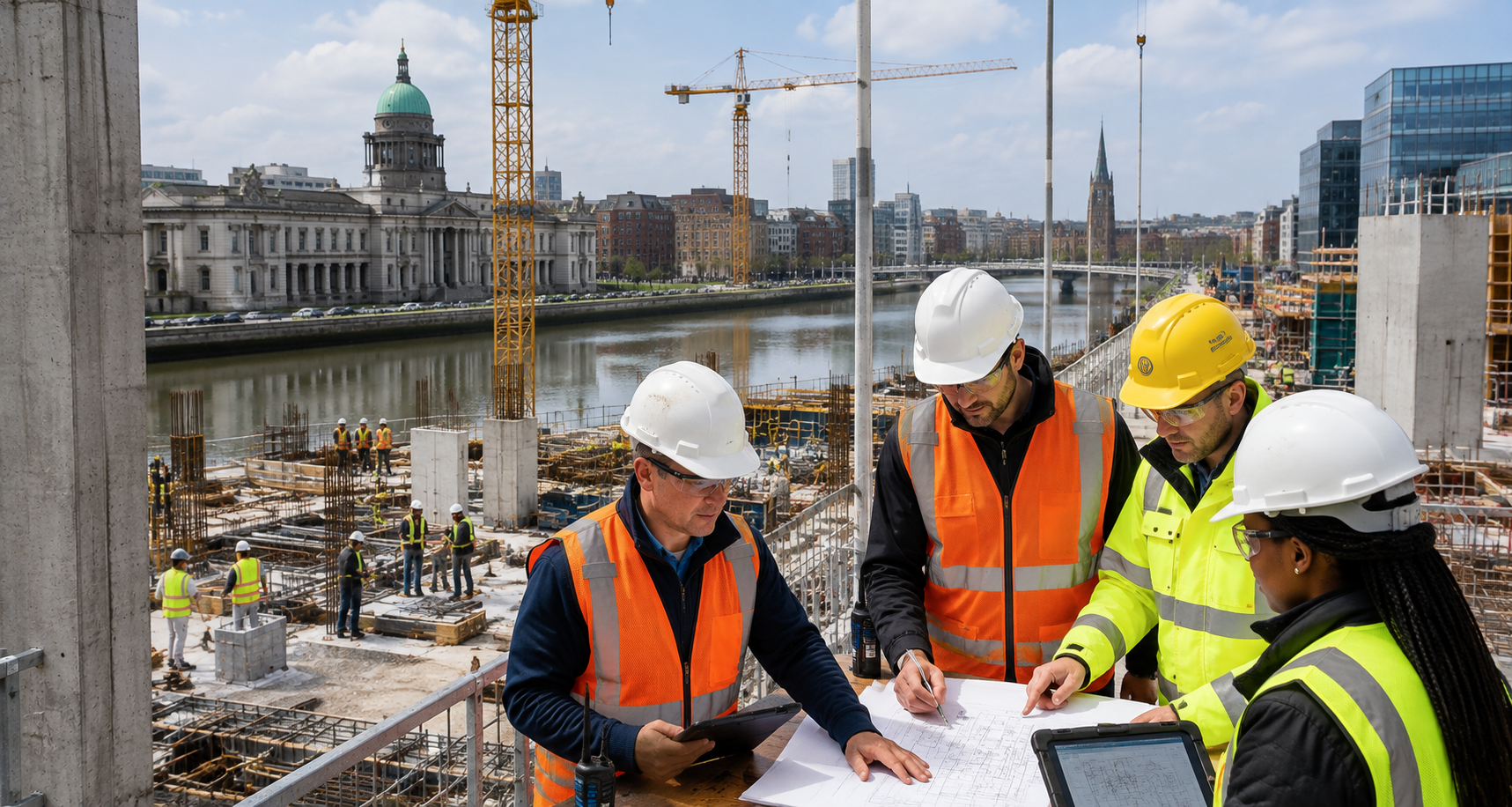
Ireland's construction pipeline is as demanding as it has been in years, and the people who lead those builds are under real pressure to deliver. For Construction Managers and Project Managers, 2026 offers some of the most challenging and rewarding work in the market, from major commercial and mission critical projects to the high-rise residential schemes reshaping Dublin. The managers who can steady a complex programme are among the most sought after professionals in the country.
Ireland's pipeline is demanding
The range of work is wide: major commercial and infrastructure programmes, mission critical builds, and a steady flow of high-rise residential in the capital. Each brings its own pressures, but they share a common thread. Clients expect more transparency, tighter schedules and stronger coordination than ever before, which places real weight on the managers holding it all together. The pace rarely lets up, and the margin for error keeps narrowing, so the value of a manager who can absorb that pressure keeps rising.
The Construction Manager on a major project
A Construction Manager on a major project is coordinating multiple trades, a demanding client and a schedule with very little slack. The job is as much about managing interfaces and information as it is about managing work on the ground. When two packages meet, or when a design query holds up a critical activity, it is the Construction Manager who has to see it early and resolve it before it turns into a delay. The strongest make the whole site feel more controlled than the pressure would suggest, because they are always looking a few weeks ahead rather than only at today.
The Project Manager on high-rise residential
A Project Manager on a high-rise residential build in Dublin is holding pace, quality and safety together at the same time, often on a constrained city site with limited space and difficult logistics. The programme rarely forgives a slow decision. Managers who do well here plan in genuine detail and keep the whole team pointed at the same milestones, so that momentum never depends on one person chasing another. They also keep quality and safety in view even when the schedule is at its loudest, because on residential work the finish is what the client ultimately judges.
From the tools to leading the build
Many of Ireland's strongest managers came up through a trade or a technical discipline before moving into management, and that grounding shows. Understanding how the work is actually done earns respect on site and sharpens judgement about what is realistic. The move into management is still a real transition though: it asks a person to lead and coordinate rather than deliver the work themselves, and to trust a team to execute. The managers who make that shift well are the ones contractors want to hold on to.
What separates the best managers
It is rarely a single quality. It is programme literacy, commercial awareness and the authority to hold people to their commitments without turning the site adversarial. Contractors talk about managers who can walk a floor, spot the thing that is about to slip and sort it quietly, often before anyone else has noticed. That instinct comes from having been through the pressure before, which is why proven experience is valued so highly. The best managers also develop the people around them, because a strong team is what lets a manager lead rather than firefight.
Coordination is the real discipline
On the biggest Irish projects, the defining challenge is coordination. Civils, structure, envelope and the mechanical and electrical works all have to be woven together under a schedule that leaves little room. A manager who plans the sequence well, communicates it clearly and holds the trades to it protects the entire programme. Increasingly, that also means being comfortable with the planning and reporting tools that keep a complex build visible, because a programme that everyone can see is a programme that is far easier to keep on track.
What contractors are prioritising in 2026
The businesses delivering these programmes are clear about what they want. They value managers who plan in detail, communicate status honestly even when it is uncomfortable, and have carried real programme pressure before. Above all they want people who steady a site rather than add to its noise. They also move quickly for the right person, because strong managers are rarely available for long. If you are ready for your next programme in Ireland, or building a delivery team, our specialists at Necto Selection can help you make the right move.